

Systemic
Facilitation
Some situations don’t need a process. They need someone who can read the room, read the system, and know the difference.
Systemic Facilitation is for the moments when the right intervention isn’t obvious, but the cost of getting it wrong is high.
Most facilitation is passive. Someone manages the agenda, keeps time, makes sure everyone gets a turn. It is professional, neutral, and largely harmless.
But there are situations where that is not enough. Where the problem in the room is not a lack of structure but a lack of honesty. Where the people who need to align hold genuinely different views of what success looks like, what their role is in delivering it, and who has the right to decide. Where something unspoken is shaping every conversation and nobody is naming it.
These are the situations that passive facilitation cannot touch. They need something altogether more skilled and more courageous.
Systemic Facilitation starts from a different place.
Before a single question is asked, there is already a reading of the system: what kind of complexity is present, what the social dynamics are, where the power sits, where the silence is, and what kind of intervention the situation actually calls for.
That reading draws on decades of experience across hundreds of organisations and thousands of facilitators trained. It draws on a deep understanding of how systems behave when people are in the room together, what holds groups stuck, what creates genuine movement, and what looks like progress but isn’t. It uses frameworks like the System of Systems Methodology to understand whether the group is working toward shared purpose, navigating genuinely competing views, or operating under pressures that nobody has yet named out loud.
That last one matters more than most organisations want to admit. Coercion in complex systems is rarely obvious and often invisible even to the people creating it. It shows up as silence, as premature agreement, as energy leaving the room at certain moments. A facilitator who can sense those dynamics, name them gently and directly, and create enough safety for something more honest to emerge is not doing facilitation as most people understand it. They are doing something far more valuable.
Systemic Facilitation is deliberately flexible in its form because the situations that call for it are endlessly varied.
Systemic Facilitation is the capstone of the architecture of systemic innovation.
Labs surface what the system knows. Discovery maps the terrain. Sprints generate and test ideas. But all of it depends on the quality of the human work in the room. Without facilitation that can navigate complexity, the best tools and processes in the world will stall at the point where people have to actually agree, decide, and move.
If you work with us through a Private Client Partnership, this kind of facilitation is available to you whenever the moment calls for it. Not as a separate engagement but as part of the ongoing relationship. For those who want to build this capability within their own teams, our Systemic Facilitation Course also offers a deep dive into the skills, tools and mindset that make it possible.
Who it is for:
Leaders and organisations facing situations where the human dynamics are as complex as the challenge itself. Where alignment feels elusive, where important things are going unsaid, or where a critical decision or process needs skilled independent facilitation to have any chance of landing well.
Systemic Facilitation works as a standalone engagement or as part of a larger piece of work. If you are not sure whether this is what the situation calls for, that conversation is a good place to start.





Neil has been working as a systemic facilitator for over 25 years, across government, regulated industries, global business and the public sector. He has trained thousands of facilitators and navigated some of the most complex and politically charged rooms imaginable. He brings warmth, precision and the kind of behavioural flexibility that only comes from genuine depth of experience.
If you would like to explore whether Systemic Facilitation is what your situation needs, there are a few ways to begin that conversation.

CLIENT TESTIMONIALS

Real people. Real organisations. Real change.
Senior leaders reflecting honestly on what it’s actually like to work with us.


“Bringing Neil into my clients is something I don’t hesitate to do. He will come in and quickly understand the most complex and most critical issues for an organisation and very quickly navigate his way around with diplomacy and humour to help them reach their goals.”
Julia Days
Talent Acquisition Transformation Consultant and Strategy Advisor, RL100 UK 2026

The Systemic
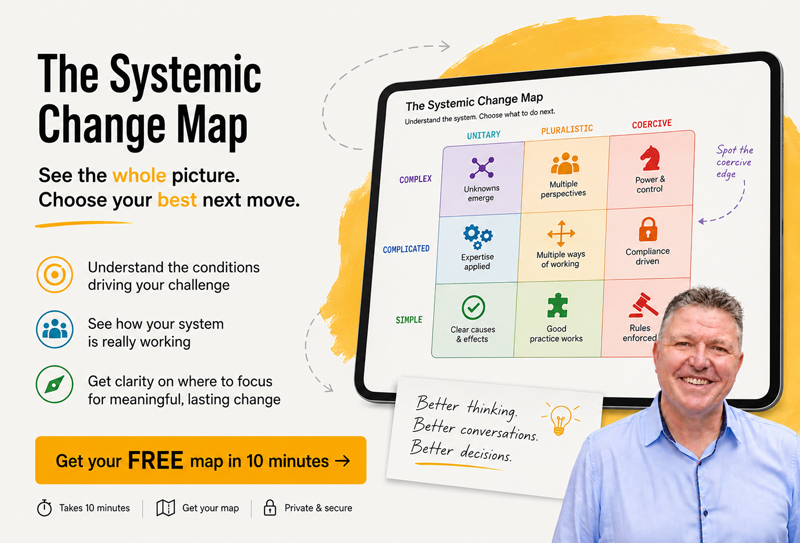
Change Map

Map how change actually happens in your organisation.
In around ten minutes, this free guided reflection helps you understand the conditions surrounding your challenge and how change actually happens in your organisation.
Other ways we can help
Systemic Dialogue Labs
Most organisations already have the answers they need. They just haven’t asked the right people in the right way.
A Systemic Dialogue Lab brings together the voices closest to the challenge, at scale and in a structured way, and surfaces what the system already knows. Fast, rich, and often revelatory.
Systemic
Discovery
Most projects fail before they really start. Neither the problem nor the system has been properly understood, the right people aren’t aligned, and there’s no agility in the map the team need to follow.
Systemic Discovery reads the system early. It gives you the clarity, the alignment and the coalition you need before the real work begins.
Systemic Innovation Sprints
Once you understand the system, you need to move. A Sprint takes insights and turns them into ideas, prototypes and real-world testing with the people who will make or break them.
Focused, fast, and grounded in the reality of how your system actually works.
Systemic
Facilitation
Sometimes the problem isn’t the problem. It’s that the right people aren’t in the room, or they’re in the room but not really talking, or they’re talking but not hearing each other.
Innovation
Coaching
Leading innovation in a complex organisation is one of the lonelier jobs there is. The challenges are systemic, the politics are real, and most coaching doesn’t touch the half of it.
Innovation Coaching is thought partnership for leaders who need someone who genuinely understands the terrain, knows how complexity operates, and can help you bring people with you.
Private Client
Partnerships
Some challenges need more than a project. They need a thinking partner who rolls up their sleeves and stays close to the work, facilitating, coaching, building capability, nurturing change and doing whatever the moment requires.
We only take on a small number of these each year. Because when we partner with a client, we go all in.