

Systemic
Discovery
The biggest risk to your innovation isn’t the idea. It’s the system waiting for it.
The system that will either make or break your innovation is already in place. Systemic Discovery helps you understand it before you commit to a direction.
Every significant innovation or change initiative begins with a brief. And almost every brief contains the same hidden assumption: that the problem is roughly what it appears to be, that the key people are roughly aligned, and that the system is roughly ready.
In our experience, none of those things are usually true.
Complex systems hide their real shape from the people inside them. The factors that will determine whether your initiative succeeds or fails, the misalignments between sponsors, the structural conditions that make certain outcomes nearly impossible, and the beliefs that make the current situation feel inevitable to the people living it are rarely visible at the surface. And they are almost never in the brief.
Systemic Discovery is the process of uncovering them before the real work begins.
We work with your key sponsors and stakeholders through a structured series of conversations, designed to surface what is really happening beneath the presenting problem. We listen for what is said and what is not. We map the patterns, the structures, and the assumptions that shape how your system actually behaves.
Most organisations, when they look back at projects that did not deliver, can see the signals were there at the beginning. The sponsors who were never quite aligned. The assumption nobody tested. The part of the system nobody thought to ask about.
Systemic Discovery is the process of finding those things while there is still time and space to respond to them.
Who it is for:
Leaders and organisations at the start of a significant initiative, or those who have tried before and want to understand clearly why things stalled.
Systemic Discovery works as the foundation for a Sprint, as the entry point into a Private Client Partnership, or as a standalone investment in understanding before major resources are committed.
If you are not sure whether this is what you need right now, that is exactly the kind of conversation we are here for.





Neil has been running systemic discovery processes for over 25 years across government, global business and the public sector. He has helped hundreds of leaders see their own systems more clearly, and more honestly, than they sometimes expected.

CLIENT TESTIMONIALS

Real people. Real organisations. Real change.
Senior leaders reflecting honestly on what it’s actually like to work with us.


“Bringing Neil into my clients is something I don’t hesitate to do. He will come in and quickly understand the most complex and most critical issues for an organisation and very quickly navigate his way around with diplomacy and humour to help them reach their goals.”
Julia Days
Talent Acquisition Transformation Consultant and Strategy Advisor, RL100 UK 2026

The Systemic
Change Map

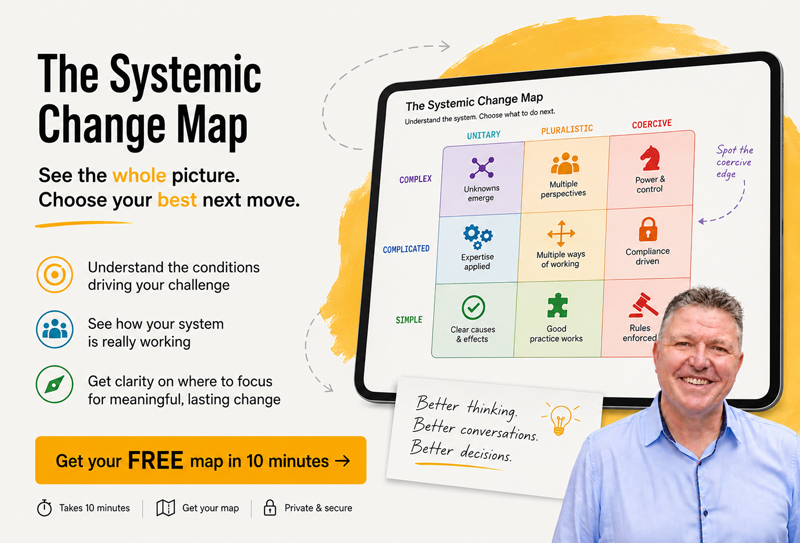
Map how change actually happens in your organisation.
In around ten minutes, this free guided reflection helps you understand the conditions surrounding your challenge and how change actually happens in your organisation.
Other ways we can help
Systemic Dialogue Labs
Most organisations already have the answers they need. They just haven’t asked the right people in the right way.
A Systemic Dialogue Lab brings together the voices closest to the challenge, at scale and in a structured way, and surfaces what the system already knows. Fast, rich, and often revelatory.
Systemic
Discovery
Most projects fail before they really start. Neither the problem nor the system has been properly understood, the right people aren’t aligned, and there’s no agility in the map the team need to follow.
Systemic Discovery reads the system early. It gives you the clarity, the alignment and the coalition you need before the real work begins.
Systemic Innovation Sprints
Once you understand the system, you need to move. A Sprint takes insights and turns them into ideas, prototypes and real-world testing with the people who will make or break them.
Focused, fast, and grounded in the reality of how your system actually works.
Systemic
Facilitation
Sometimes the problem isn’t the problem. It’s that the right people aren’t in the room, or they’re in the room but not really talking, or they’re talking but not hearing each other.
Innovation
Coaching
Leading innovation in a complex organisation is one of the lonelier jobs there is. The challenges are systemic, the politics are real, and most coaching doesn’t touch the half of it.
Innovation Coaching is thought partnership for leaders who need someone who genuinely understands the terrain, knows how complexity operates, and can help you bring people with you.
Private Client
Partnerships
Some challenges need more than a project. They need a thinking partner who rolls up their sleeves and stays close to the work, facilitating, coaching, building capability, nurturing change and doing whatever the moment requires.
We only take on a small number of these each year. Because when we partner with a client, we go all in.