

Systemic
dialogue labs.
Your organisation already knows more than it thinks it does.
A Systemic Dialogue Lab surfaces what your system already knows.
Most organisations listen to their systems in fragments. A survey here, a focus group there, an away day that generated a lot of Post-its and very little movement.
The problem isn’t that people aren’t trying. It’s that the methods weren’t designed for complexity. They were designed for simpler systems where you can ask a straight question and get a straight answer.
That’s what a Systemic Dialogue Lab does. Not a survey. Not a workshop. Something altogether more alive than either.
A Lab brings together the people who matter, from a handful of key voices to several hundred people from across the system, and asks them questions designed to surface what's really going on.
Not what people think they should say. What they actually know, feel, and believe about the challenge you’re facing.
You know that feeling when a fog you've been navigating for months suddenly clears? When something you couldn't quite articulate becomes not just visible but obvious?
That’s what clients describe after a Lab. Not just data. Not just themes. A genuine sense of the system, where the energy is, where the blockages are, what the people closest to the work already know about what needs to change.
And because the people who participated helped create that picture, something else happens too. They feel part of what comes next. That’s not a side effect. It’s part of how change in complex systems actually works.
Who it is for:
Leaders and organisations facing complex challenges where the path forward isn’t clear, and where the people who might know the answer haven’t properly been asked.
Systemic Dialogue Labs work well as a standalone intervention, as the listening foundation before a larger piece of work, or as part of a Systemic Discovery process.
If you’re not sure whether a Lab is what you need, then let’s talk and explore.





Neil has been facilitating systemic dialogue for over 25 years, working with organisations from government departments to global businesses. He has sat with hundreds of groups in the complexity of not quite knowing what’s really going on, and helped them find out.
If you’d like to explore whether a Systemic Dialogue Lab is right for your organisation, there are a few ways to start that conversation.

CLIENT TESTIMONIALS

Real people. Real organisations. Real change.
Senior leaders reflecting honestly on what it’s actually like to work with us.


“Bringing Neil into my clients is something I don’t hesitate to do. He will come in and quickly understand the most complex and most critical issues for an organisation and very quickly navigate his way around with diplomacy and humour to help them reach their goals.”
Julia Days
Talent Acquisition Transformation Consultant and Strategy Advisor, RL100 UK 2026

The Systemic
Change Map

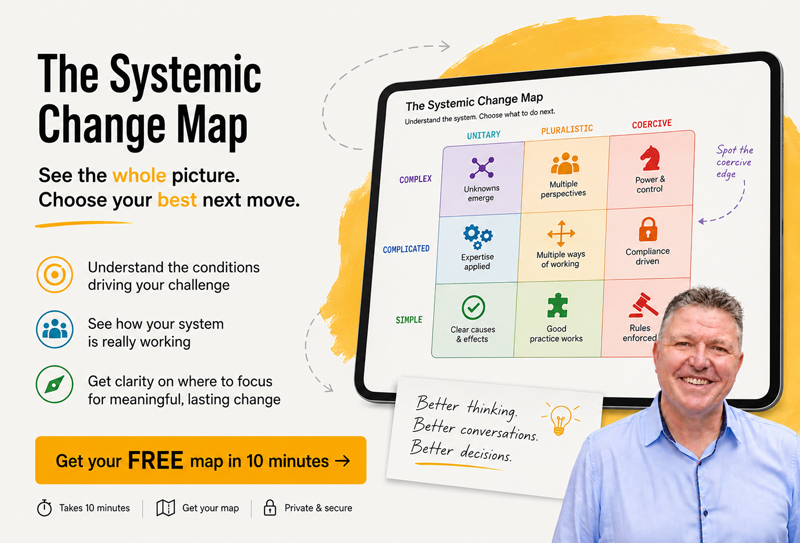
Map how change actually happens in your organisation.
In around ten minutes, this free guided reflection helps you understand the conditions surrounding your challenge and how change actually happens in your organisation.
Other ways we can help
Systemic Dialogue Labs
Most organisations already have the answers they need. They just haven’t asked the right people in the right way.
A Systemic Dialogue Lab brings together the voices closest to the challenge, at scale and in a structured way, and surfaces what the system already knows. Fast, rich, and often revelatory.
Systemic
Discovery
Most projects fail before they really start. Neither the problem nor the system has been properly understood, the right people aren’t aligned, and there’s no agility in the map the team need to follow.
Systemic Discovery reads the system early. It gives you the clarity, the alignment and the coalition you need before the real work begins.
Systemic Innovation Sprints
Once you understand the system, you need to move. A Sprint takes insights and turns them into ideas, prototypes and real-world testing with the people who will make or break them.
Focused, fast, and grounded in the reality of how your system actually works.
Systemic
Facilitation
Sometimes the problem isn’t the problem. It’s that the right people aren’t in the room, or they’re in the room but not really talking, or they’re talking but not hearing each other.
Innovation
Coaching
Leading innovation in a complex organisation is one of the lonelier jobs there is. The challenges are systemic, the politics are real, and most coaching doesn’t touch the half of it.
Innovation Coaching is thought partnership for leaders who need someone who genuinely understands the terrain, knows how complexity operates, and can help you bring people with you.
Private Client
Partnerships
Some challenges need more than a project. They need a thinking partner who rolls up their sleeves and stays close to the work, facilitating, coaching, building capability, nurturing change and doing whatever the moment requires.
We only take on a small number of these each year. Because when we partner with a client, we go all in.