

Systemic
Innovation
Sprints
A Sprint takes what you know about your system and turns it into ideas worth testing, prototypes worth showing, and momentum worth building on.
Most innovation processes start with a blank canvas. Anything is possible. The ideas flow. The Post-its multiply. And then, somewhere between the workshop and the real world, almost everything stops.
Not because the ideas were bad. Because they weren’t designed for the system they had to land in.
A Systemic Innovation Sprint works differently. It starts with the system you are actually working in, its constraints, its politics, its existing assets and its real stakeholders, and uses that as the creative material rather than trying to work around it.
This matters more than it might sound. When ideas are built from within the constraints of a system rather than despite them, they fit better. They feel less threatening to the people who have to approve them. They are easier to prototype, faster to test, and far more likely to actually stick. In regulated environments, where the constraints are significant and the appetite for risk is low, this is the difference between an idea that survives sign-off and one that dies in committee..
Sprints come in different sizes, because challenges come in different sizes.
Both formats use the same principles. Work within constraints. Build from what the system already has. Use reframing tools to generate ideas with enough variety to match the complexity of the challenge. Test early, test cheaply, and keep the system close throughout.
The difference between a Sprint and most ideation processes runs deeper than method. It starts before the room and it doesn't end when you leave it.
Every Sprint is shaped around your specific challenge, your specific constraints, your specific system. The map we make is a map of your territory.
Who it is for:
leaders, teams and organisations with a defined challenge that needs fresh thinking, whether that is a specific block to get past or a larger innovation opportunity to explore.
Sprints work well following a Systemic Dialogue Lab or Systemic Discovery process, where the system is already understood and the work is ready to move into ideas and prototypes. They can also be run as a standalone intervention when the challenge is clear enough to work from directly.
If you are not sure which format fits your situation, that is a good conversation to have before committing to anything.





Neil has been designing and facilitating innovation sprints for over 25 years, across sectors from nuclear and defence to government and global business. He has helped hundreds of teams move from stuck to prototype faster than they expected, and with ideas that actually survived the journey back to the real world.
If you would like to explore whether a Sprint is the right next step for your challenge, there are a few ways to start that conversation.

CLIENT TESTIMONIALS

Real people. Real organisations. Real change.
Senior leaders reflecting honestly on what it’s actually like to work with us.


“Bringing Neil into my clients is something I don’t hesitate to do. He will come in and quickly understand the most complex and most critical issues for an organisation and very quickly navigate his way around with diplomacy and humour to help them reach their goals.”
Julia Days
Talent Acquisition Transformation Consultant and Strategy Advisor, RL100 UK 2026

The Systemic
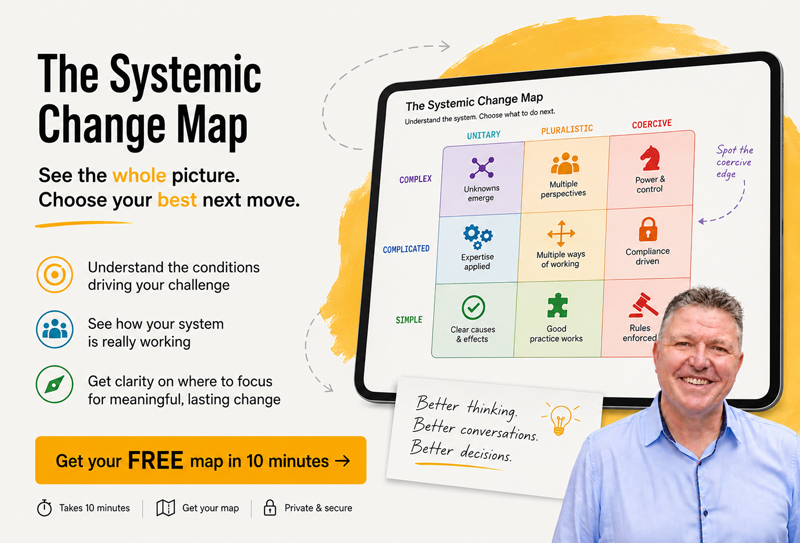
Change Map

Map how change actually happens in your organisation.
In around ten minutes, this free guided reflection helps you understand the conditions surrounding your challenge and how change actually happens in your organisation.
Other ways we can help
Systemic Dialogue Labs
Most organisations already have the answers they need. They just haven’t asked the right people in the right way.
A Systemic Dialogue Lab brings together the voices closest to the challenge, at scale and in a structured way, and surfaces what the system already knows. Fast, rich, and often revelatory.
Systemic
Discovery
Most projects fail before they really start. Neither the problem nor the system has been properly understood, the right people aren’t aligned, and there’s no agility in the map the team need to follow.
Systemic Discovery reads the system early. It gives you the clarity, the alignment and the coalition you need before the real work begins.
Systemic Innovation Sprints
Once you understand the system, you need to move. A Sprint takes insights and turns them into ideas, prototypes and real-world testing with the people who will make or break them.
Focused, fast, and grounded in the reality of how your system actually works.
Systemic
Facilitation
Sometimes the problem isn’t the problem. It’s that the right people aren’t in the room, or they’re in the room but not really talking, or they’re talking but not hearing each other.
Innovation
Coaching
Leading innovation in a complex organisation is one of the lonelier jobs there is. The challenges are systemic, the politics are real, and most coaching doesn’t touch the half of it.
Innovation Coaching is thought partnership for leaders who need someone who genuinely understands the terrain, knows how complexity operates, and can help you bring people with you.
Private Client
Partnerships
Some challenges need more than a project. They need a thinking partner who rolls up their sleeves and stays close to the work, facilitating, coaching, building capability, nurturing change and doing whatever the moment requires.
We only take on a small number of these each year. Because when we partner with a client, we go all in.